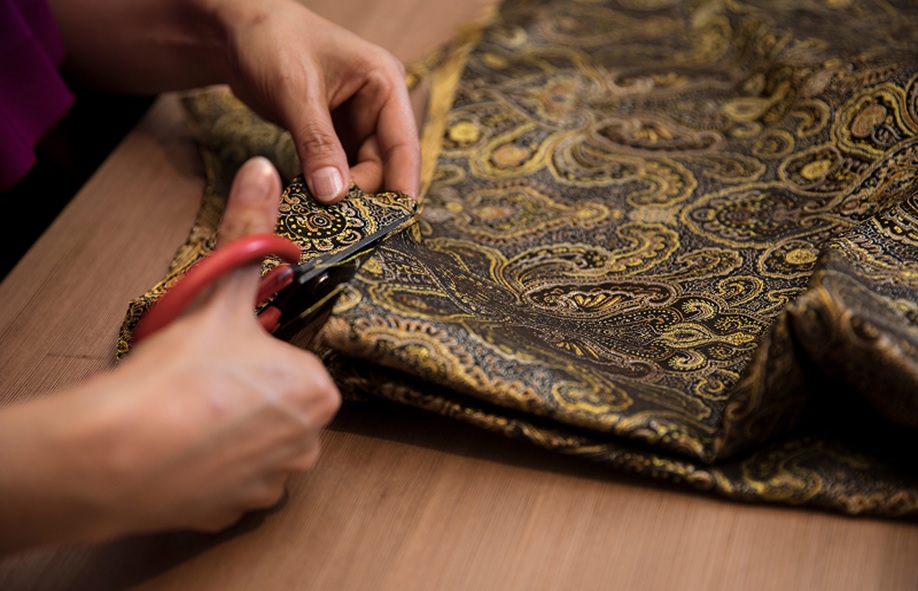
Nyonya batik grew out of the north coast of Java, in trading towns such as Pekalongan, where Peranakan Chinese communities favoured softer colours, flowing florals, birds and butterflies over the bolder, more geometric patterns of central Javanese batik. Those motifs are still the reason many people reach for it today. They also make it one of the most demanding fabrics to cut. Lay a length of Nyonya batik on a tailor’s table next to a bolt of linen, and you’ll see two completely different sets of decisions waiting to be made before the first snip of the scissors.
What a Tailor Looks for in a Length of Nyonya Batik
With batik, the pattern comes first. A tailor will usually unroll the whole length, study where the main motifs fall and decide which ones should sit at the front, over the shoulders or along the hem. A large peony or phoenix that lands awkwardly across the hip can change the whole look of a cheongsam.
- Motif placement: Key motifs are often centred on the front panel or used to frame the neckline.
- Pattern direction: Birds, flowers and borders need to face the right way on every panel, which can use up more fabric.
- Matching at seams: Fitted styles look neater when patterns line up across darts and side seams.
- Borders and panels: Some batik lengths include distinct border designs that work well along a hem or slit.
This is why buying a ready-made Nyonya batik cheongsam appeals to so many people. The placement decisions have already been made by someone who has spent time with the pattern, so the motifs sit where they’re meant to.
Linen Asks a Different Set of Questions
Linen is less about where the pattern lands and more about how the fabric moves. Woven from flax fibres, it’s known for being breathable and quick to dry, which is exactly why linen clothing in Singapore makes so much sense for daily wear in a humid climate. On the cutting table, though, it behaves very differently from a crisp cotton batik.
Linen tends to have a looser drape and creases easily, so it’s often cut with more ease through the body rather than closely fitted. Relaxed, Japanese-influenced silhouettes, with dropped shoulders, wide sleeves or straight cuts, suit it well because they let air move around the body. Many linen fabrics can also shrink slightly when first washed, so tailors working with raw linen often pre-wash it before cutting.
Side by Side on the Table
| Consideration | Nyonya batik | Linen |
| First priority | Where the motifs land | How the fabric drapes |
| Typical fit | Often more fitted, as in a cheongsam | Usually relaxed, with room to breathe |
| Fabric use | Pattern matching can need extra length | Plain weaves allow more flexible layouts |
| Before cutting | Check pattern direction and borders | Consider pre-washing for shrinkage |
| Best moments | Weddings, Chinese New Year, formal events | Everyday wear, travel, weekends |
Do You Need a Tailor for Either?
Not necessarily. Anmako’s batik cheongsam range turns batik into four ready-to-wear silhouettes, from relaxed cuts to a classic maxi, so the motif placement and fitting work is already done. The Japanese cotton-linen collection does the same for everyday wear, with cuts designed around linen’s natural drape, which makes shopping for linen clothing in Singapore far simpler than sourcing fabric and finding someone to sew it. If you have a tailor you trust and a specific design in mind, raw fabric gives you full control. If you’d rather wear it this weekend, a finished piece takes the guesswork out of it.
Caring for Each Fabric After It Leaves the Table
- Hand wash batik in cold water, and soak it briefly in water with a little vinegar or salt before its first wash.
- Dry batik away from direct sunlight so the colours don’t fade unevenly.
- Wash linen gently and avoid high heat in the dryer to limit shrinkage.
- Iron linen while slightly damp, or simply embrace a few relaxed creases.
- Expect small irregularities in handmade batik; they’re part of the craft rather than a flaw.
Both fabrics reward a little patience. Nyonya batik shows its character in the care taken over every motif, while linen clothing in Singapore earns its place through comfort in the heat and the way it softens with every wash. Choosing between them often comes down to the occasion, but knowing how each is cut helps you appreciate why the finished pieces look and feel the way they do.
Planning a batik cheongsam for a special occasion or building a linen wardrobe for everyday wear? Contact Anmako and the team can help you find the right piece, size or fabric for what you have in mind.
