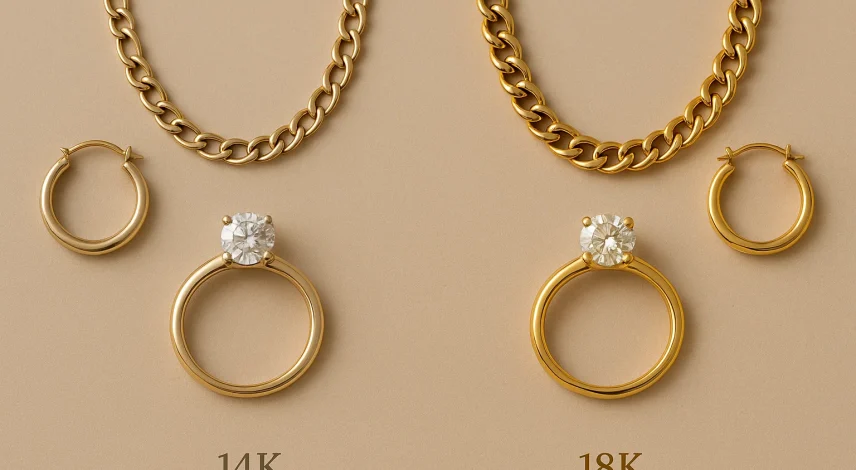
Ask five jewelers about 14K vs 18K gold for everyday wear, and you’ll get five different answers. One swears by 18K’s richer color. The next calls 14K the only sensible pick. So who’s right? Honestly, it depends on your routine, your budget, and the piece itself. For most everyday jewelry, solid 14K gold lands in the sweet spot: durable enough to live in, rich enough to love. Here’s the straight breakdown so you can choose once and never second-guess it.
Is 14K or 18K Gold Better for Everyday Wear?
For most people, 14K gold is the better choice for everyday wear. It’s harder, more affordable, and lower-maintenance. 18K offers a richer yellow color and higher gold content, in exchange for a softer, pricier piece.
So why does the advice sound so contradictory? Three reasons. Different countries have different norms. Europe leans 18K by tradition; the US treats 14K as standard. Jewelers define “durable” differently. Some mean “won’t bend,” others mean “holds its color.” And price, markup, and design complexity all quietly shape what someone recommends.
| 14K Gold | 18K Gold | |
| Gold content | 58.3% | 75% |
| Everyday durability | Harder, holds up better | Softer, marks more easily |
| Color | Warm, slightly softer yellow | Deeper, richer yellow |
| Price | More accessible | Noticeably higher |
| Upkeep | Lower | A little more |
Is 18K Gold Too Soft for Daily Wear?
No. 18K gold isn’t too soft for daily wear, but it is softer than 14K. The difference is alloy. 14K is 58.3% gold and 41.7% alloy; 18K is 75% gold and 25% alloy. More pure gold means a deeper color and a slightly more bendable metal.
Here’s what most people miss: alloy isn’t the “cheap” part. Pure 24K gold is too soft to wear hard, so the alloy metals give gold its strength, color, and wearability. 14K’s higher alloy content makes it harder. It holds its shape and shrugs off day-to-day marks a little better. 18K can dent or bend slightly more over the years, especially in thin pieces. Both last decades with normal wear.
What about sensitive skin? That’s rarely about the karat; it’s the alloy recipe. Nickel is a common alloy metal across the industry, and it’s usually the culprit behind irritation. The fix is a nickel-free alloy: with no nickel in the mix, the gold itself never works against your skin.
What Matters More Than Karat When Choosing Everyday Gold Jewelry?
Beyond the karat number, four things matter just as much for everyday gold jewelry:
- Band or post thickness: substance protects a piece more than the stamp inside it.
- The setting and how low it sits against the skin.
- Chain construction: gauge, link style, and weight.
- How you actually wear it day to day.
An ultra-thin band bends faster than a sturdy one, in any karat, so weight and build matter more than the number alone. Settings are about style and feel: prongs, bezels, and low-profile designs each sit differently against the skin, all engineered to the same standard. On chains, a solid chain carries more heft than a hollow one (hollow is still real gold, just lighter), so pick the weight you love. For earrings, a smooth post and flat back decide all-day comfort far more than karat. Well-made flat back earrings sit low-profile, so they settle in and stay put. And lifestyle seals it: desk job, gym, shower, sleep, travel, hands-on days. Solid gold takes all of it.
Color and Price: Where 18K Pulls Ahead
18K pulls ahead in two places: color and, sometimes, cost. It shows a deeper yellow, and its higher price usually reflects more actual gold. Here’s how both play out.
More gold means a deeper, warmer yellow; 14K reads slightly softer beside it. Rose gold flips the script: lower karat can actually look pinker, because there’s more copper in the mix. In white gold it barely matters: both karats are finished with rhodium, which hides the color difference entirely. One tip: compare 14K and 18K from the same maker under the same light, since recipes vary by brand.
On price, the higher number is usually fair, not a markup trick. But if an 18K piece costs far more than its gold content explains, it’s reasonable to ask why. And keep perspective: jewelry isn’t bullion. You’re buying design and craftsmanship you’ll wear for years, not a gold bar priced by the gram.
Does 14K or 18K Gold Tarnish, Scratch, or Need More Care?
Neither solid 14K nor 18K gold tarnishes. Solid gold simply doesn’t. 14K gold jewelry resists scratches a little better; 18K shows fine marks slightly more. Both need only occasional care.
| Concern | 14K Solid Gold | 18K Solid Gold |
| Tarnish | No | No |
| Scratch resistance | Slightly higher | Slightly lower |
| White gold (rhodium) | Occasional re-coat | Occasional re-coat |
| Daily upkeep | Wipe + occasional rinse | Wipe + occasional rinse |
When people say “tarnish,” they usually mean a plated piece wearing through to base metal. Solid gold has no coating to wear off, so it stays itself. White gold in either karat is finished with rhodium; over time that bright layer softens, and a quick re-coat refreshes it: an occasional touch-up, not a flaw. Beyond that, glance at your prongs now and then and wipe pieces down. This is why solid gold beats plated and gold-filled jewelry long-term: no coating to give out on you.
Best choice by type? For rings and wedding bands you’ll never take off, 14K’s hardness wins, which is why most everyday gold bands are made in 14K. Necklaces and pendants rest at the collar, so either karat is comfortable. Earrings come down to the post and back. Bracelets take more knocks, so 14K helps. And for an heirloom or occasional piece, 18K’s richer color is a lovely splurge.
Bottom line: Choose 14K for everyday durability, value, and lower maintenance. Choose 18K when you want deeper color and higher gold content and don’t mind a little extra care. Either way, buy solid gold, and ask about the alloy and the build before you commit. Buy once, and wear it for years.
FAQs
Can you shower with 14K or 18K gold? Yes. Solid gold won’t tarnish or react, so showering, swimming, and workouts are all fine. No need to take it off. Rinse and wipe it occasionally to keep it bright.
Is 14K or 18K gold better for sensitive skin? Both can be. Skin reactions usually trace back to nickel in the alloy, not the gold itself. A nickel-free alloy keeps the gold comfortable against reactive skin, so look for pieces made without nickel.
Can you wear 14K and 18K gold together? Yes. Mixing karats is purely a styling choice. Within the same gold color, 14K and 18K sit together comfortably, and the slight difference in warmth is subtle enough to read as intentional.
Is 14K solid gold better than gold-plated jewelry? For everyday wear, yes. Plated jewelry is base metal under a thin gold layer that wears through. Solid 14K gold is gold all the way through, with no coating to fade.
